
In 2025, 46.5% of EU enterprises with ten or more persons employed used ERP software to share information between business functions, 28.5% used CRM software and 52.7% bought paid cloud computing services, according to Eurostat. Belgium (62.5%) ranks 2 of 27 EU countries for ERP use, the Netherlands leads this group for CRM (54.1%) and cloud (68.5%), and Germany (43.5%) and Austria (37.5%) sit below the EU average for ERP.
Key takeaways
- ERP use in EU enterprises reached 46.5% in 2025, up 3.1 percentage points from 2023 and 10.5 points from 35.9% in 2019.
- Belgium, France, the Netherlands and Luxembourg are above the EU average for ERP; Germany and Austria are below it, and Austria's share fell between 2023 and 2025.
- CRM software is used by 28.5% of EU enterprises and business intelligence software by 16.3%; the Netherlands (54.1%) ranks 2 of 27 for CRM.
- Paid cloud use rose by 7.4 points in two years, to 52.7%. Finance or accounting software is the business application most often bought as a cloud service (30.7% of enterprises), ahead of cloud ERP (15.9%) and cloud CRM (14.7%).
- Size matters least for cloud finance or accounting software: 29.1% of small enterprises use it against 45.6% of large ones, while the ERP figures are 41.1% and 88.7%.
How many European enterprises use ERP software?
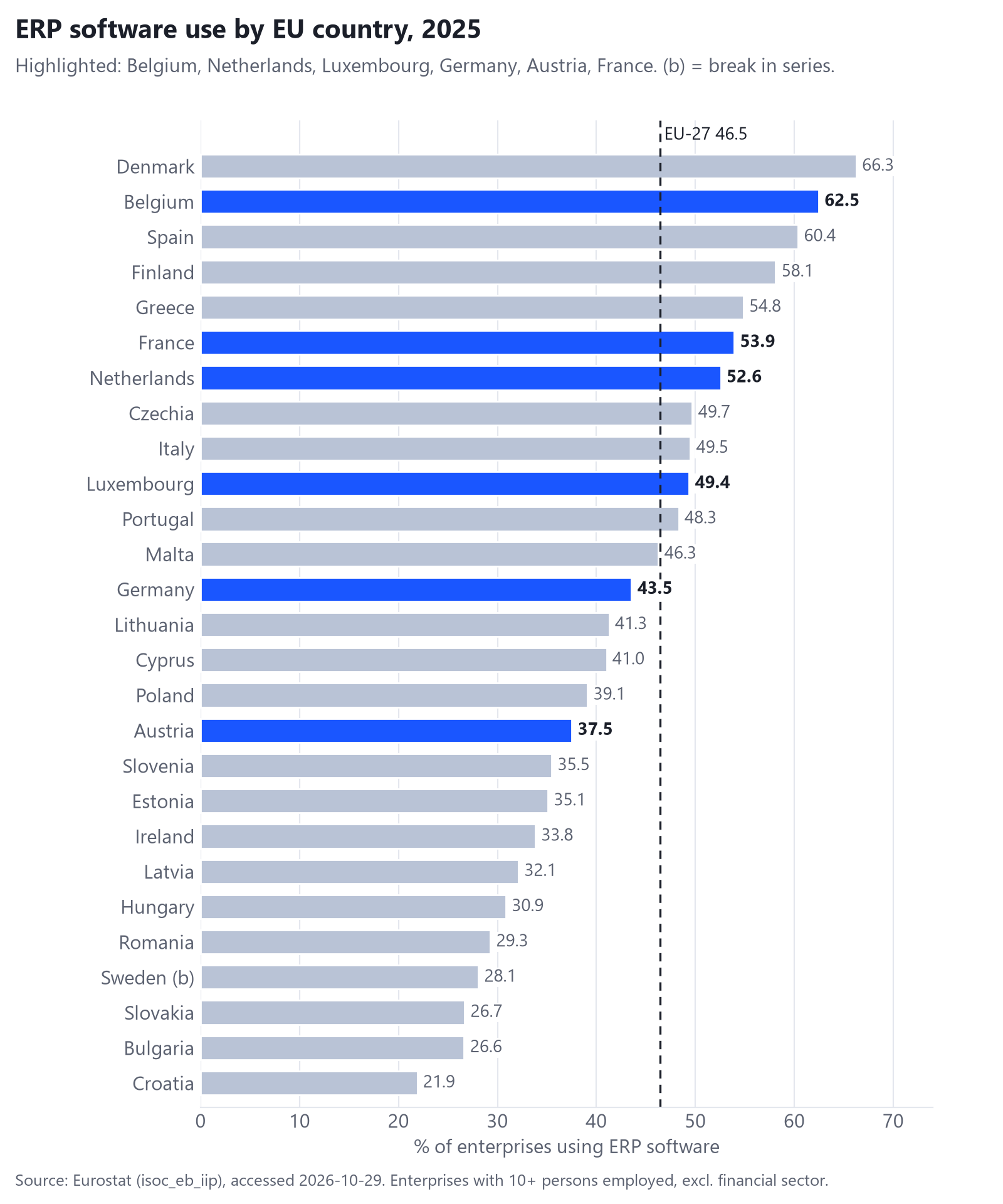
Close to half. In 2025, 46.5% of EU enterprises with ten or more persons employed used an enterprise resource planning (ERP) software package to share information between different functional areas, such as planning, purchasing, sales and finance. The share was 35.9% in 2019, 37.9% in 2021 and 43.4% in 2023. 11 of the 27 member states are above the EU figure. The highest shares are in Denmark (66.3%), Belgium (62.5%) and Spain (60.4%), and the lowest is in Croatia (21.9%).
Belgium has the highest share of the six countries covered here, at 62.5%. France (53.9%, rank 6), the Netherlands (52.6%, rank 7) and Luxembourg (49.4%, rank 10) are also above the EU average. Germany (43.5%) is below it, and Austria (37.5%) ranks 17 of 27. France added 6.6 points and Luxembourg 5.5 between 2023 and 2025, while Austria's share fell by 2.6 points and Germany's was almost unchanged (43.7% in 2023, 43.5% in 2025). France's 2023 figure carries a break-in-series flag, explained in the methodology section.
| Country | 2023 | 2025 | Change (pp) | EU rank, 2025 |
|---|---|---|---|---|
| EU-27 | 43.4 | 46.5 | +3.1 | – |
| Belgium | 59.5 | 62.5 | +2.9 | 2 of 27 |
| Netherlands | 51.9 | 52.6 | +0.7 | 7 of 27 |
| Luxembourg | 43.8 | 49.4 | +5.5 | 10 of 27 |
| Germany | 43.7 | 43.5 | −0.2 | 13 of 27 |
| Austria | 40.1 | 37.5 | −2.6 | 17 of 27 |
| France | 47.3 (b) | 53.9 | +6.6 | 6 of 27 |
(b) = break in time series. pp = percentage points. Source: Eurostat, isoc_eb_iip.
How widely are CRM and business intelligence software used?
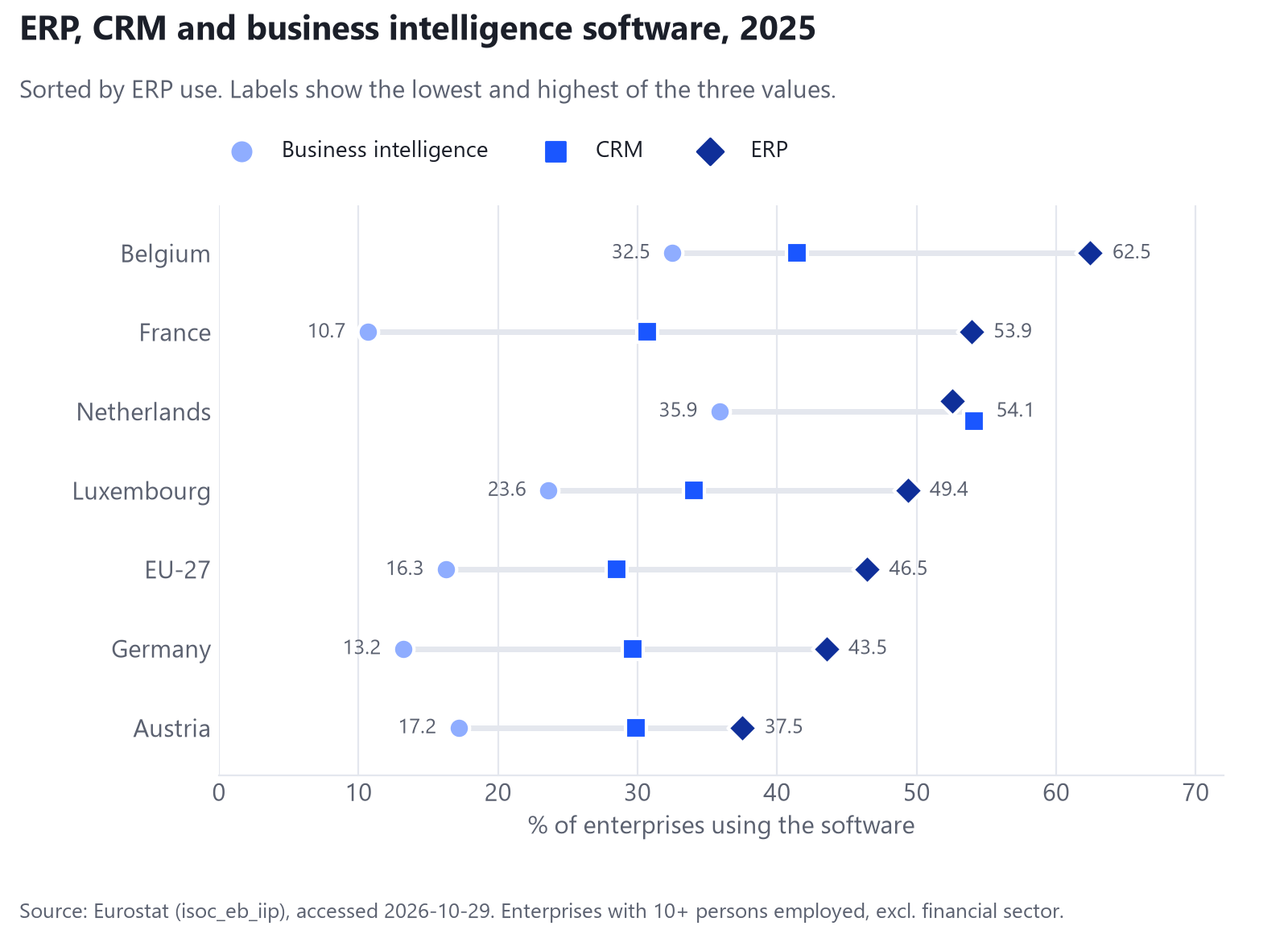
Less widely than ERP. In 2025, 28.5% of EU enterprises used customer relationship management (CRM) software, up from 25.8% in 2023. Business intelligence (BI) software, which analyses data from internal systems and other sources and presents it in reports and dashboards, was used by 16.3%. 53.5% used at least one of the three.
The Netherlands stands out on CRM. 54.1% of Dutch enterprises use it, which ranks 2 of 27 behind Finland (55.8%), and it is the only country in this group where CRM is more common than ERP. Belgium follows at 41.4% (rank 4). The Netherlands (35.9%) and Belgium (32.5%) are also well above the EU average for BI, while Germany (13.2%) and France (10.7%) are below it.
| Country | CRM, 2023 | CRM, 2025 | BI, 2025 | ERP, CRM or BI, 2025 |
|---|---|---|---|---|
| EU-27 | 25.8 | 28.5 | 16.3 | 53.5 |
| Belgium | 39.4 | 41.4 | 32.5 | 69.7 |
| Netherlands | 50.6 | 54.1 | 35.9 | 69.6 |
| Luxembourg | 30.4 | 34.0 | 23.6 | 58.8 |
| Germany | 27.5 | 29.6 | 13.2 | 51.4 |
| Austria | 29.7 | 29.9 | 17.2 | 46.9 |
| France | 24.5 | 30.7 | 10.7 | 60.2 |
(b) = break in time series. pp = percentage points. Source: Eurostat, isoc_eb_iip.
How does use differ by enterprise size?
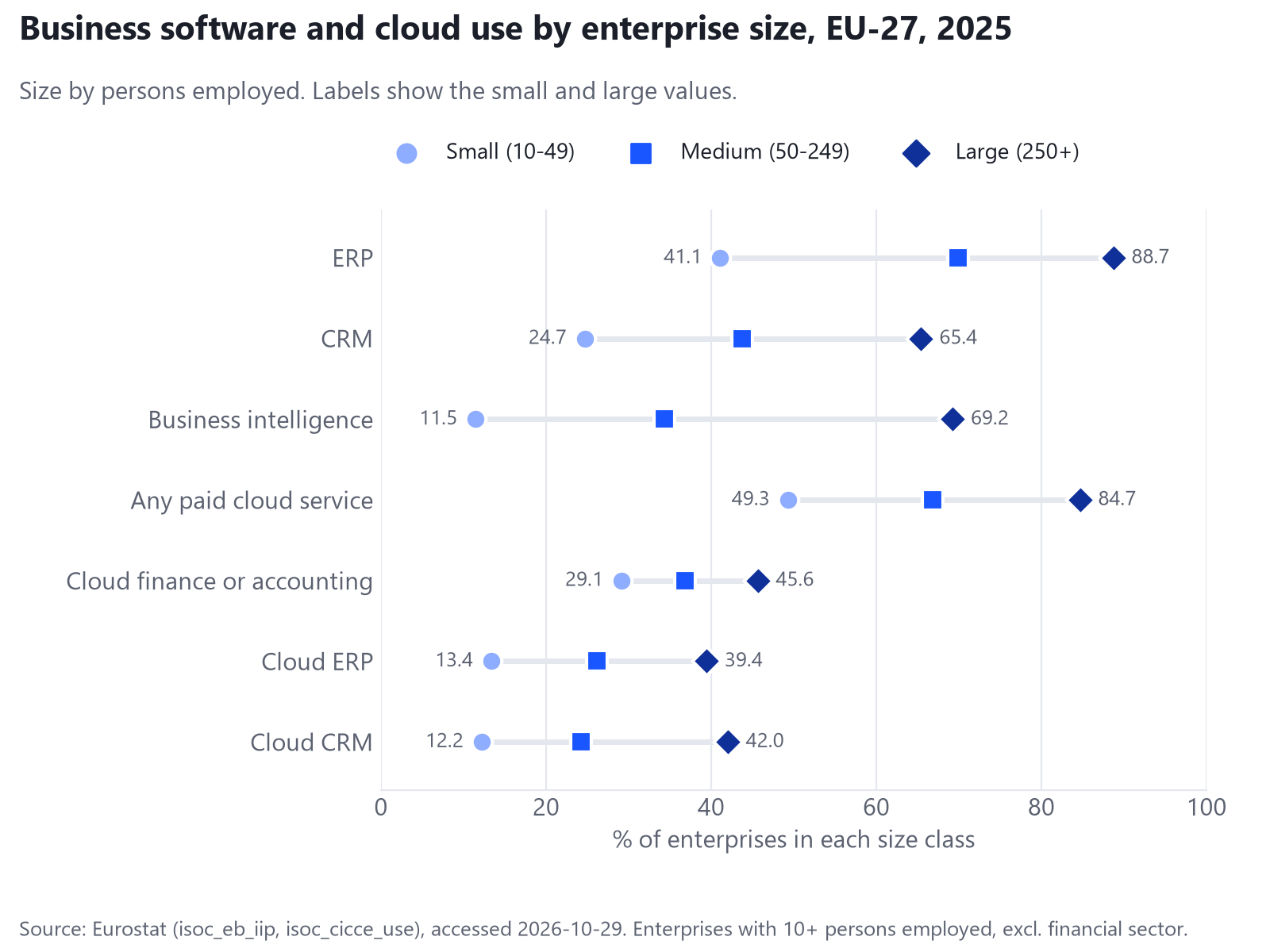
Strongly, and most of all for analysis tools. In the EU, 88.7% of enterprises with 250 or more persons employed use ERP, against 69.9% of medium enterprises (50-249) and 41.1% of small enterprises (10-49), a ratio of about 2.2 to one. For CRM the figures are 65.4% and 24.7%. Business intelligence shows the widest gap: 69.2% of large enterprises use it, against 11.5% of small ones.
Small Belgian enterprises (56.8%) use ERP more often than the average EU enterprise of any size (46.5%). Austria shows the opposite: its large enterprises (91.6%) are above the EU figure for large firms (88.7%), but its small enterprises have the lowest share in this group (30.9%), so the ratio between large and small is about 3.0 to one.
| Country | Small (10-49) | Medium (50-249) | Large (250+) | Large / small |
|---|---|---|---|---|
| EU-27 | 41.1 | 69.9 | 88.7 | 2.2 |
| Belgium | 56.8 | 84.4 | 94.5 | 1.7 |
| Netherlands | 45.9 | 76.4 | 87.7 | 1.9 |
| Luxembourg | 43.8 | 69.3 | 81.1 | 1.9 |
| Germany | 37.5 | 67.7 | 89.4 | 2.4 |
| Austria | 30.9 | 66.4 | 91.6 | 3.0 |
| France | 48.9 | 80.1 | 92.6 | 1.9 |
Size class by persons employed. Source: Eurostat, isoc_eb_iip.
Eurostat's survey metadata note that about 83% of EU enterprises with ten or more persons employed are small, so national figures move mainly when small firms adopt.
How many enterprises buy cloud computing services?
Just over half. In 2025, 52.7% of EU enterprises bought paid cloud computing services, up from 45.3% in 2023. Eurostat counts a service as cloud computing when it runs on the provider's servers, is used over the internet, can be scaled up or down on demand and is paid for. The highest shares are in Finland (79.2%), Italy (75.6%) and Malta (75.1%); the lowest is in Bulgaria (17.8%).
In this group, the Netherlands (68.5%, rank 7) and Belgium (61.6%, rank 8) are highest. Germany (53.9%) is just above the EU average and Austria (52.1%) just below it, while Luxembourg (47.7%) and France (40.4%) are further below. Cloud and ERP do not line up: France and Luxembourg are above the EU average for ERP and below it for cloud, and Germany is the other way round. Every country here grew between 2023 and 2025; Belgium added 9.9 points and Luxembourg 10.7.
| Country | 2023 | 2025 | Change (pp) | EU rank, 2025 |
|---|---|---|---|---|
| EU-27 | 45.3 | 52.7 | +7.4 | – |
| Belgium | 51.7 | 61.6 | +9.9 | 8 of 27 |
| Netherlands | 64.2 | 68.5 | +4.3 | 7 of 27 |
| Luxembourg | 37.0 | 47.7 | +10.7 | 18 of 27 |
| Germany | 47.0 | 53.9 | +6.9 | 13 of 27 |
| Austria | 46.5 | 52.1 | +5.6 | 14 of 27 |
| France | 26.8 (b) | 40.4 | +13.7 | 22 of 27 |
(b) = break in time series. pp = percentage points. Source: Eurostat, isoc_cicce_use.
Which business applications do enterprises run in the cloud?
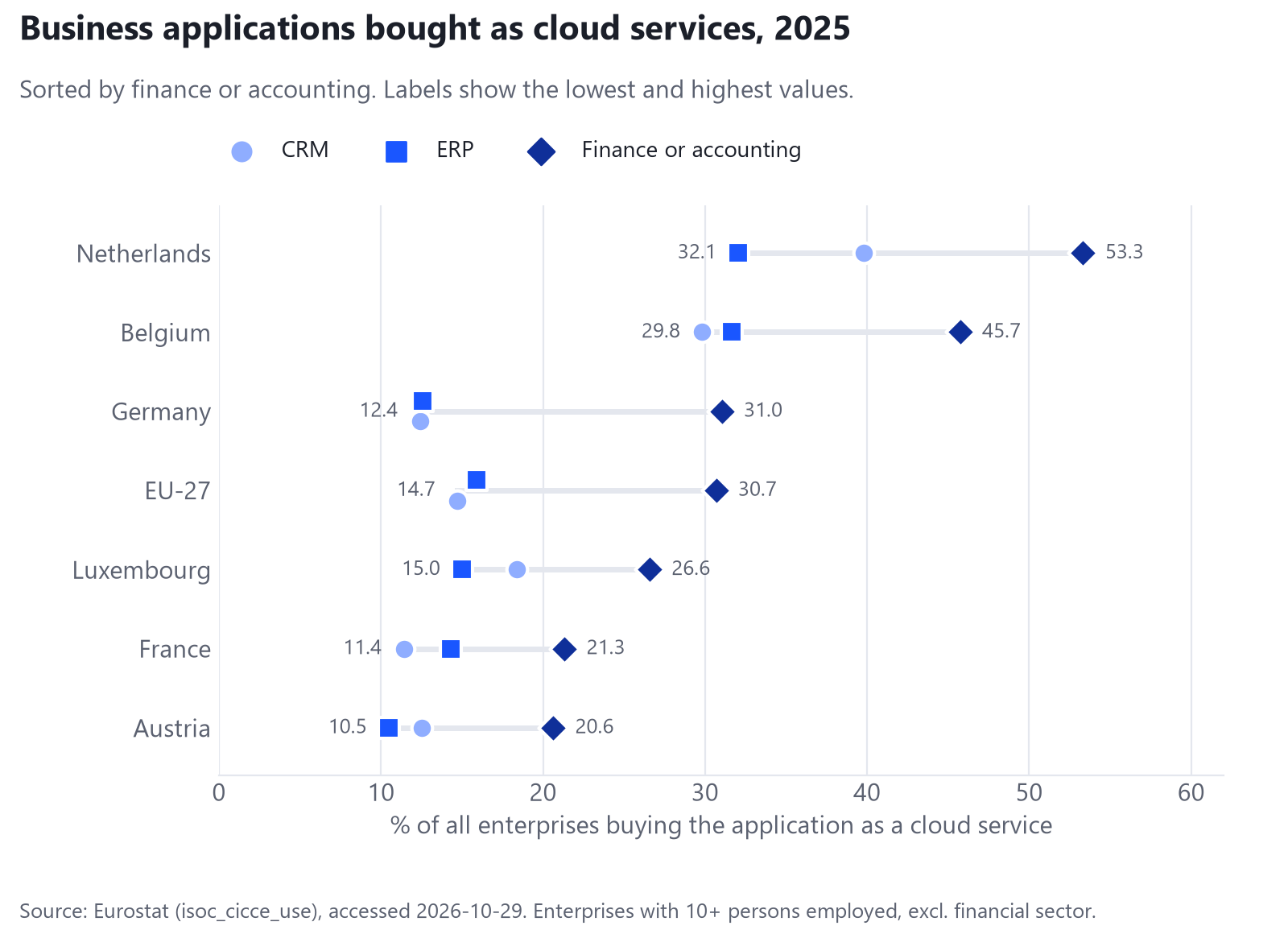
Finance first. In 2025, 30.7% of all EU enterprises bought finance or accounting software as a cloud service, 15.9% bought ERP and 14.7% bought CRM. Among enterprises that buy any paid cloud service, the shares are 58.2%, 30.1% and 27.9%. Between 2023 and 2025, cloud finance or accounting grew by 7.3 points and cloud ERP by 4.2 points.
Belgium and the Netherlands lead this group by a wide margin. Cloud ERP reaches 31.7% in Belgium (rank 4) and 32.1% in the Netherlands (rank 3), and cloud CRM reaches 39.8% in the Netherlands (rank 2). In Belgium, 51.4% of enterprises that buy cloud services include ERP among them, against 30.1% in the EU. Austria has the lowest shares in this group for cloud finance or accounting (20.6%) and cloud ERP (10.5%). Luxembourg's cloud ERP share rose from 7.1% in 2023 to 15.0% in 2025.
| Country | Finance or accounting | ERP | CRM |
|---|---|---|---|
| EU-27 | 30.7 | 15.9 | 14.7 |
| Belgium | 45.7 | 31.7 | 29.8 |
| Netherlands | 53.3 | 32.1 | 39.8 |
| Luxembourg | 26.6 | 15.0 | 18.4 |
| Germany | 31.0 | 12.6 | 12.4 |
| Austria | 20.6 | 10.5 | 12.5 |
| France | 21.3 | 14.3 | 11.4 |
Each application is a separate survey item; an enterprise can buy several. Source: Eurostat, isoc_cicce_use.
Cloud ERP and ERP use are separate questions, so the survey does not show what share of ERP users run ERP in the cloud.
Methodology and limitations
All figures come from the EU survey on ICT usage and e-commerce in enterprises, run by the national statistical institutes on a common Eurostat model questionnaire. In 2025, 157,000 enterprises were surveyed out of around 1.53 million EU enterprises with ten or more persons employed. The survey covers most of the business economy but excludes the financial sector, agriculture, forestry, fishing, and mining and quarrying.
- Definitions. ERP means using an ERP software package to share information between different functional areas. CRM and BI are counted if the enterprise uses the software at all. Cloud figures count paid services only, and each application (finance or accounting, ERP, CRM) is a separate yes or no item.
- Years. In recent survey rounds the business software and cloud questions were asked every second year, so 2025 is the newest value and 2023 the comparison year. A 2024 cloud value exists for the Netherlands only and is not used.
- Comparability. Eurostat publishes CRM use from 2023 under a new indicator code, which its metadata describe as the result of a changed question, so CRM figures from 2021 or earlier are not compared with these. The ERP indicator code has not changed since 2019, which is why the EU ERP series is shown from 2019.
- Flags. Eurostat marks France's 2023 ERP and cloud values with a break in the time series (b), so France's changes in those indicators between 2023 and 2025 are indicative. Sweden's 2025 ERP figure also carries the flag; it appears only in the ranking chart. No value printed here is flagged as having low reliability, and values Eurostat withholds are left out rather than estimated.
- Scope. Small means 10-49 persons employed, medium 50-249 and large 250 or more. Micro-enterprises with fewer than ten persons employed are not part of these figures. Switzerland does not take part in this survey, so it has no comparable figure.
- Computations. Changes are differences in percentage points between published values, ranks are positions among the 27 member states, and ratios divide the large-enterprise share by the small-enterprise share. All values are rounded to one decimal after the calculation.
The raw responses, the dataset codes and the access date (29 October 2026) are kept with this article, so every figure can be traced to its Eurostat cell.
What this means for SMEs integrating their systems
The data measure which systems enterprises use, not how well they are connected. With that limit, four points help planning.
- Benchmark against small enterprises, not the national average. Large firms pull national figures up. The small-enterprise figures for each country are in the table below.
- Finance software is where small and large firms are closest. Cloud finance or accounting software is used by 29.1% of small EU enterprises and 45.6% of large ones, a ratio of about 1.6 to one, against about 2.2 for ERP and 2.7 for CRM. When accounting runs as a cloud service and sales or stock data sit in other tools, it is worth deciding early how records move between them, for example through the documented interfaces each provider offers.
- Several systems are counted separately. CRM (24.7% of small EU enterprises) and ERP (41.1%) are separate survey items, and the survey does not show whether they are linked. A simple list of which system holds customer, order and invoice records is a low-cost first step before adding another tool.
- Reporting depends on joined-up data. Business intelligence is the least common of these tools among small enterprises (11.5%). Reports that combine sales, finance and operations need data that can be matched across systems. The same survey shows a similar size divide for AI use in European enterprises.
| Country | ERP | CRM | Any paid cloud | Cloud finance or accounting | Cloud ERP |
|---|---|---|---|---|---|
| EU-27 | 41.1 | 24.7 | 49.3 | 29.1 | 13.4 |
| Belgium | 56.8 | 36.3 | 57.1 | 43.1 | 27.8 |
| Netherlands | 45.9 | 49.6 | 64.5 | 51.3 | 28.4 |
| Luxembourg | 43.8 | 29.9 | 44.7 | 25.3 | 13.9 |
| Germany | 37.5 | 26.0 | 50.7 | 30.9 | 11.3 |
| Austria | 30.9 | 25.4 | 48.1 | 19.6 | 9.0 |
| France | 48.9 | 27.1 | 35.8 | 17.8 | 11.2 |
Source: Eurostat, isoc_eb_iip and isoc_cicce_use.
Frequently Asked Questions
What share of EU enterprises use ERP software?
In 2025, 46.5% of EU enterprises with ten or more persons employed used ERP software to share information between functional areas, according to Eurostat. That is up from 43.4% in 2023 and 35.9% in 2019. The share is 41.1% for small enterprises and 88.7% for large enterprises.
Which EU country uses ERP software the most?
Denmark, at 66.3% in 2025, followed by Belgium (62.5%) and Spain (60.4%). The lowest share is in Croatia (21.9%).
How many Belgian enterprises use ERP, CRM and cloud services?
In 2025, 62.5% of Belgian enterprises with ten or more persons employed used ERP software, 41.4% used CRM software and 32.5% used business intelligence software. 61.6% bought paid cloud services, including 45.7% that bought finance or accounting software and 31.7% that bought ERP as a cloud service.
How many enterprises use cloud ERP or cloud CRM?
In the EU, 15.9% of enterprises bought ERP software as a cloud service in 2025 and 14.7% bought CRM software. The highest shares in the EU are 39.8% for cloud ERP in Denmark and 39.9% for cloud CRM in Finland.
Can CRM figures before 2023 be compared with 2025?
No. Eurostat changed the CRM question in 2023 and published it under a new indicator code, so earlier CRM figures are not directly comparable. The change between 2023 and 2025, 2.7 percentage points in the EU, is comparable.
Does Eurostat publish ERP or cloud figures for Switzerland?
No. The survey covers EU member states, Iceland, Norway and candidate countries, so Switzerland has no figure in these datasets.
Conclusion
Eurostat's 2025 data show ERP, CRM and paid cloud services all spreading in European enterprises, with Belgium and the Netherlands among the most frequent users and Austria and Germany behind on ERP. Large enterprises are ahead on every item, and the size gap is narrowest for cloud finance software. This summary was compiled by Rui Codex, a software engineering company based in Belgium; teams planning a systems integration project can send a project request.
Sources
- Integration of internal processes by size class of enterprise (isoc_eb_iip) - Eurostat
- Cloud computing services by size class of enterprise (isoc_cicce_use) - Eurostat
- ICT usage in enterprises: reference metadata - Eurostat
- E-business integration (Statistics Explained) - Eurostat
- Cloud computing - statistics on the use by enterprises (Statistics Explained) - Eurostat
